What Is a Top-Level Domain (TLD)? Examples & Types Explained
Every website on the internet has a unique address that allows users to find and access it. While most people recognize familiar web addresses such as google.com, wikipedia.org, or amazon.com, few understand the technical components that make up these addresses. One of the most important parts of any website address is the Top Level Domain, commonly known as a TLD.
Top-level domains play a critical role in the internet's naming system. They help organize websites, establish credibility, support branding, and even influence how users perceive a business online. Whether you're registering a new domain name, launching a business website, or simply learning about how the internet works, understanding TLDs is essential.
In this comprehensive guide, we'll explain what a Top Level Domain is, how it fits into the overall Domain Structure, the different types of TLDs available today, and how to choose the right one for your website.
What Is a Top-Level Domain (TLD)?
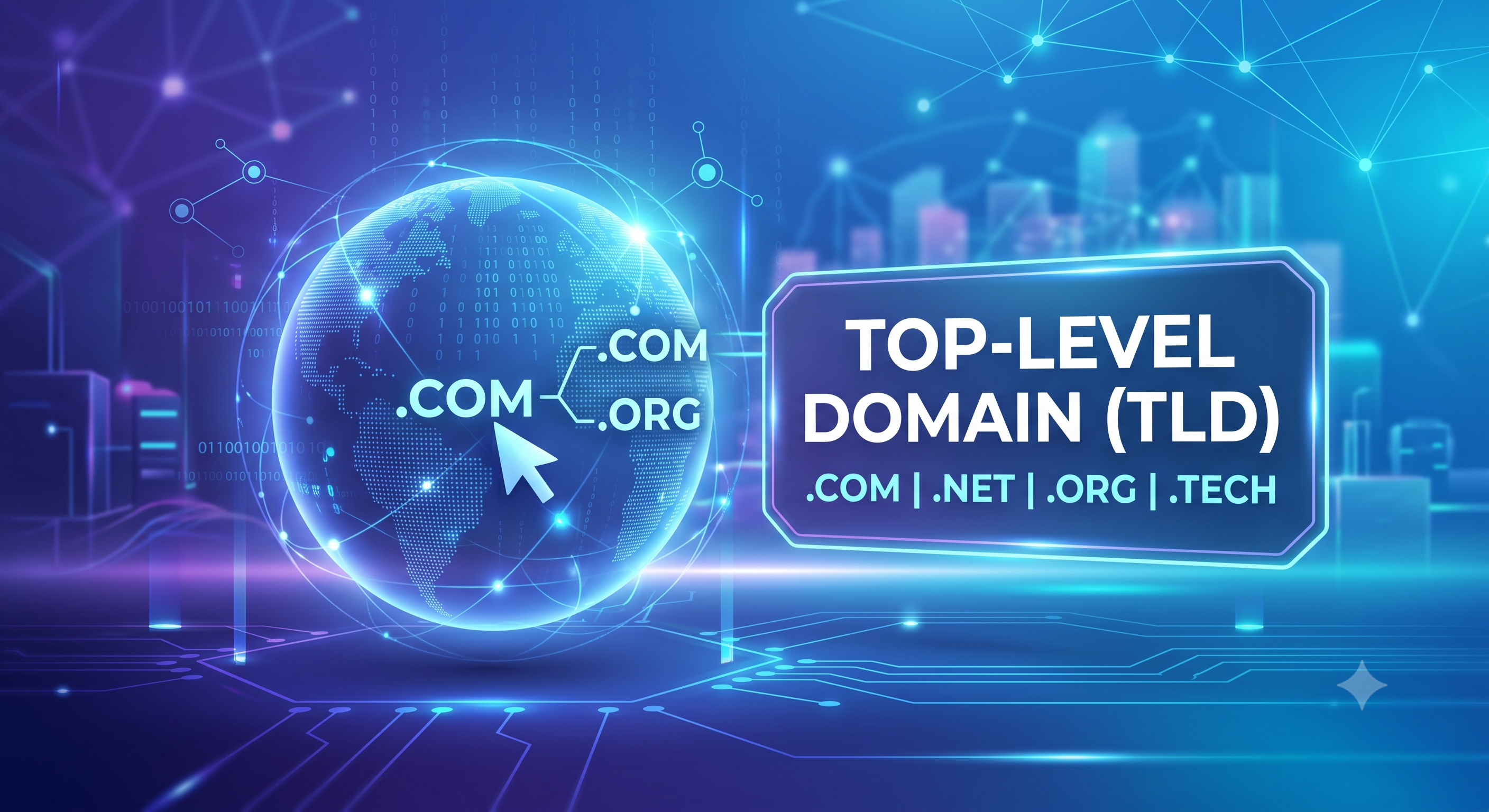
A Top Level Domain (TLD) is the last segment of a domain name that appears after the final dot. For example:
- google.com
- wikipedia.org
- microsoft.net
- openai.ai
In each example, the extension following the dot is the TLD. These are often referred to as Domain Extensions because they extend the main domain name.
TLDs are managed within the global Domain Name System (DNS), which acts as the internet's address book by translating human-readable domain names into IP addresses that computers use to communicate.
Understanding Domain Structure
To fully understand TLDs, it's important to understand the overall Domain Structure.
Consider the domain:
blog.example.com
This domain consists of multiple levels:
- .com = Top-Level Domain (TLD)
- example = Second-Level Domain (SLD)
- blog = Subdomain
Together, these components create a complete web address that directs users to specific content on the internet.
Why Are TLDs Important?
TLDs serve several important functions beyond simply completing a website address.
Organization of the Internet
TLDs help categorize and organize millions of Website Domains across the internet.
Brand Recognition
Certain domain extensions are instantly recognizable and can strengthen brand credibility.
User Trust
Users often associate familiar TLDs such as .com and .org with trustworthy websites.
Geographic Targeting
Country-specific TLDs help businesses target local audiences more effectively.
Industry Identification
Modern domain extensions can communicate a website's purpose or industry at a glance.
History of Top-Level Domains
The first TLDs were introduced in 1985 as part of the early internet infrastructure. Originally, only a handful of domain extensions existed:
- .com
- .org
- .net
- .edu
- .gov
- .mil
As the internet expanded globally, hundreds of new TLDs were introduced to meet growing demand and provide greater flexibility for businesses, organizations, and individuals.
Types of Top-Level Domains
Modern TLDs generally fall into several major categories.
1. Generic Top-Level Domains (gTLDs)
Generic TLDs are among the most widely recognized and commonly used domain extensions.
Examples
- .com
- .org
- .net
- .info
- .biz
These extensions are not tied to a specific country and are available globally.
Best For
- Businesses
- Blogs
- Organizations
- Personal websites
2. Country Code Top-Level Domains (ccTLDs)
Country code TLDs are assigned to specific countries and territories.
Examples
- .uk (United Kingdom)
- .ca (Canada)
- .au (Australia)
- .in (India)
- .de (Germany)
Businesses targeting local markets often use ccTLDs to strengthen geographic relevance.
Benefits
- Local trust
- Regional branding
- Market-specific positioning
3. Sponsored Top-Level Domains (sTLDs)
Sponsored TLDs are managed by specific organizations and intended for particular communities or industries.
Examples
- .edu
- .gov
- .mil
- .museum
- .travel
Registration requirements often restrict who can use these domain extensions.
4. New Generic Top-Level Domains
In recent years, hundreds of new domain extensions have been introduced to provide greater flexibility and branding opportunities.
Examples
- .app
- .shop
- .store
- .blog
- .tech
- .agency
- .online
These modern TLDs allow businesses to create highly relevant and memorable domain names.
Most Popular TLDs Explained
.com
The most popular domain extension in the world, .com is widely recognized and trusted. It remains the preferred choice for businesses and commercial websites.
.org
Commonly associated with nonprofits and community organizations, .org conveys trust and credibility.
.net
Originally intended for networking organizations, .net is now a popular alternative when .com domains are unavailable.
.io
Widely adopted by technology startups and software companies, .io has become a modern branding favorite.
.ai
Increasingly popular among artificial intelligence companies and AI-focused startups.
How TLDs Affect Branding
Choosing the right TLD can significantly impact branding and user perception.
A familiar domain extension often:
- Improves memorability
- Builds trust
- Strengthens professionalism
- Supports marketing efforts
For example, many users automatically assume a business website uses a .com extension. Choosing a different TLD may require additional branding efforts to establish credibility.
Do TLDs Affect SEO?
One of the most common misconceptions is that certain TLDs automatically rank better in search engines.
Search engines generally treat most generic TLDs equally. A .com domain does not receive a direct ranking advantage over a .net or .org domain simply because of the extension.
However, TLDs can indirectly influence SEO by affecting:
- Click-through rates
- User trust
- Brand recognition
- Direct traffic
Country-specific TLDs may also help search engines identify regional targeting for local search results.
How to Choose the Right TLD
Selecting the right TLD depends on your goals, audience, and branding strategy.
Choose .com If:
- You run a business.
- You want maximum credibility.
- You target a global audience.
Choose .org If:
- You operate a nonprofit.
- You focus on education or public service.
- You want to emphasize trust.
Choose a ccTLD If:
- You serve a specific country.
- You focus on local customers.
- You want stronger regional branding.
Choose a New TLD If:
- You want a unique brand identity.
- Your preferred .com is unavailable.
- Your industry aligns with a niche extension.
Monitoring Domain Registration and Expiration
Once you've chosen the ideal TLD and registered your domain, it's important to monitor expiration dates and renewal schedules.
Allowing a valuable domain to expire can result in losing ownership and potentially damaging your brand.
To track domain expiration dates and registration status, use a Domain Expiry Checker Tool to verify renewal timelines and monitor important website domains.
Common TLD Mistakes to Avoid
- Choosing a TLD solely based on trends.
- Ignoring user trust factors.
- Overlooking local targeting needs.
- Failing to secure multiple extensions.
- Not monitoring domain renewals.
Avoiding these mistakes can help ensure a stronger and more sustainable online presence.
Conclusion
A Top Level Domain is a fundamental part of every web address and plays a vital role in the internet's overall Domain Structure. From classic domain extensions such as .com, .org, and .net to modern alternatives like .app and .tech, TLDs help categorize and identify millions of Website Domains worldwide.
Understanding the different types of Domain Extensions, their purposes, and their impact on branding and user trust allows website owners to make informed decisions when registering domains.
Whether you're building a personal blog, launching a startup, operating a nonprofit organization, or expanding a global business, choosing the right TLD can contribute significantly to your online success and long-term digital strategy.