Domain Name Services Explained: Everything You Need to Know (2026)
Most people understand that every website needs a domain name, but far fewer understand the services that make domain names work behind the scenes.
From domain registration and DNS management to domain security and renewal monitoring, domain name services are the foundation of every successful website.
Whether you're launching your first website, managing multiple business domains, or simply trying to understand how website domains function, learning about domain services is essential in 2026.
In this comprehensive guide, we'll explain what domain name services are, how they work, why they're important, and the key components of modern domain management.
By the end, you'll understand DNS, domain registration, domain security, and the tools that keep website domains running smoothly.
What Are Domain Name Services?
Domain name services are the collection of systems, tools, and processes that allow domain names to function properly on the internet.
These services help users register, manage, secure, and connect domain names to websites, email servers, and other online resources.
Without domain services, users would need to remember numerical IP addresses instead of easy-to-remember website names.
Examples of Domain Services
- Domain registration
- DNS management
- Domain transfers
- WHOIS privacy protection
- Domain renewal management
- Domain security services
- Nameserver configuration
- Subdomain management
Together, these services make website domains accessible, secure, and reliable.
Why Domain Name Services Matter
Every website depends on domain services to remain accessible to visitors.
Even if your website hosting is working perfectly, a DNS issue or expired domain can make your entire website unreachable.
Benefits of Proper Domain Management
- Reliable website accessibility
- Improved security
- Professional email functionality
- Brand protection
- Reduced downtime
- Better business continuity
Effective domain management helps ensure your online presence remains available and protected.
Domain Registration: The Foundation of Domain Services
The first step in using a domain name is domain registration.
Domain registration is the process of reserving a unique domain name through an accredited domain registrar.
How Domain Registration Works
- Choose a domain name.
- Check availability.
- Select a domain extension.
- Register through a domain registrar.
- Pay the registration fee.
- Configure DNS settings.
Once registered, you gain the right to use that domain name for a specified registration period.
Popular Domain Extensions
- .com
- .org
- .net
- .io
- .co
- .ai
- .app
The domain extension you choose can impact branding and user perception.
Understanding DNS (Domain Name System)
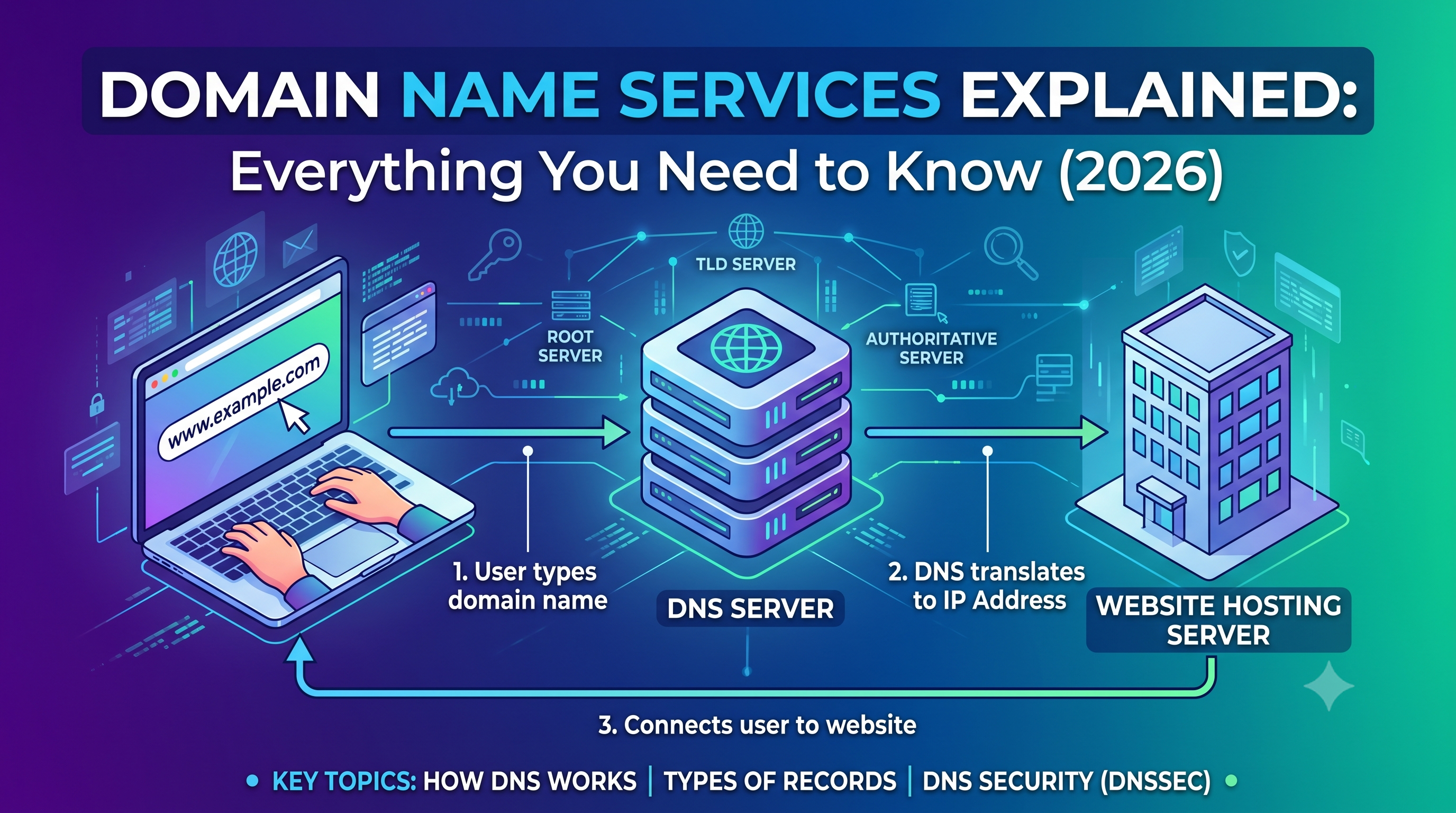
The Domain Name System, commonly called DNS, is one of the most important domain services.
DNS acts as the internet's phonebook.
It translates human-readable domain names into machine-readable IP addresses.
How DNS Works
- A user enters a domain name into a browser.
- The DNS system receives the request.
- DNS locates the associated IP address.
- The browser connects to the correct server.
- The website loads.
This process usually occurs in milliseconds.
Simple DNS Analogy
Think of DNS like your phone contacts list.
- You search for a person's name.
- Your phone finds the associated number.
- You connect instantly.
DNS performs the same function for websites.
Common DNS Records Explained
DNS management involves configuring different record types.
A Record
Points a domain to an IPv4 address.
AAAA Record
Points a domain to an IPv6 address.
CNAME Record
Creates an alias that points one domain or subdomain to another.
MX Record
Directs email traffic to mail servers.
TXT Record
Stores text-based verification and security information.
NS Record
Specifies which nameservers manage DNS for a domain.
Understanding these records is a critical part of domain management.
What Is Domain Management?
Domain management refers to the ongoing administration of website domains and related services.
After registering a domain, owners must actively manage settings, renewals, DNS records, and security features.
Domain Management Tasks
- Managing DNS records
- Updating nameservers
- Monitoring expiration dates
- Renewing registrations
- Managing subdomains
- Configuring email records
- Enabling security protections
Strong domain management reduces the risk of outages and security incidents.
Domain Security: Protecting Your Website Domains
Domain security has become increasingly important as cyber threats continue to evolve.
A compromised domain can result in website downtime, email disruptions, data theft, or even loss of domain ownership.
Common Domain Security Threats
- Domain hijacking
- Unauthorized transfers
- DNS attacks
- Registrar account compromise
- Phishing attacks
- Expired domain takeovers
Domain Security Best Practices
- Enable two-factor authentication (2FA)
- Use strong passwords
- Enable registrar lock
- Monitor DNS changes
- Keep contact information updated
- Enable domain privacy protection
Modern businesses should treat domain security as seriously as website security.
What Is Domain Privacy Protection?
Domain privacy protection hides sensitive registration details from public WHOIS databases.
Without privacy protection, domain owners may expose personal contact information publicly.
Benefits of Domain Privacy
- Reduced spam
- Improved privacy
- Better security
- Protection against targeted attacks
Most modern registrars offer WHOIS privacy protection as part of their domain services.
Nameservers and Their Role in Domain Services
Nameservers are specialized servers that manage DNS information for a domain.
When you connect a domain to a hosting provider, you often update your nameserver settings.
Example Nameservers
- ns1.provider.com
- ns2.provider.com
These nameservers tell the internet where your DNS records are stored.
Subdomains and Domain Services
Subdomains allow website owners to create separate sections under a primary domain.
Examples
- blog.example.com
- shop.example.com
- support.example.com
Subdomains are managed through DNS settings and are commonly used for different website functions.
Domain Expiration and Renewal Management
One of the most critical domain services is monitoring expiration dates.
If a domain expires, websites, email services, and connected applications may stop working.
Businesses should regularly check domain expiration dates to ensure important website domains remain active and protected.
What Happens When a Domain Expires?
- The registration expires.
- The website may become unavailable.
- Email services can fail.
- The domain enters a grace period.
- The domain may eventually become available for public registration.
Using a domain expiry checker can help prevent costly mistakes and accidental domain loss.
Domain Transfers Explained
A domain transfer moves a domain registration from one registrar to another.
Reasons to Transfer a Domain
- Better pricing
- Improved customer support
- Enhanced security features
- Consolidated domain management
Most domain transfers require authorization codes and verification steps.
Choosing the Right Domain Service Provider
Not all domain service providers offer the same features.
What to Look For
- Competitive pricing
- Reliable DNS infrastructure
- Strong security tools
- Free WHOIS privacy
- Easy-to-use management dashboard
- Responsive support
The right provider can simplify domain management and improve long-term reliability.
Common Domain Management Mistakes
- Forgetting renewals
- Ignoring security settings
- Using weak account passwords
- Failing to monitor DNS changes
- Not enabling registrar lock
- Using outdated contact information
Most domain-related issues can be avoided through proactive management.
Frequently Asked Questions About Domain Name Services
Do I Need DNS Management?
Yes. DNS management is required to connect your domain to websites, email providers, and other online services.
Can I Register a Domain Without Hosting?
Yes. Domains and hosting are separate services and can be purchased independently.
How Often Should I Check Domain Expiration Dates?
You should regularly monitor domain registrations using a domain expiration checker tool and enable automatic renewals whenever possible.
Is Domain Privacy Worth It?
For most individuals and businesses, domain privacy protection is highly recommended for security and privacy reasons.
Final Thoughts: Understanding Domain Name Services in 2026
Domain name services are the invisible infrastructure that keeps the internet functioning smoothly.
From domain registration and DNS management to domain security and renewal monitoring, these services ensure website domains remain accessible, secure, and reliable.
Whether you're managing a single website or an entire portfolio of domains, understanding domain services is essential for protecting your online presence.
By implementing strong domain management practices, monitoring expiration dates, securing registrar accounts, and maintaining accurate DNS configurations, you can avoid common issues and ensure long-term website stability.
As businesses continue to rely on digital channels in 2026, effective domain management remains one of the most important components of online success.